
A Canvas of Hope: Life, Art, and the Aftermath of USAID
- Mihira Karra
- Mar 20
- 6 min read

Walking into the Compass Atelier in the Washington D.C. area earlier this month felt like stepping into a time capsule and a sanctuary all at once. The room was absolutely packed. It got so hot downstairs because there must have been over 150 people crammed into the reception room and the surrounding corridor. It was standing room only. But looking around that space and seeing the faces of my old friends and colleagues made it a truly wonderful afternoon. It was incredibly bittersweet.

We were all gathered for Global Rhythms: Remembering USAID through the Arts. Looking around the room, the sheer amount of expertise gathered in one place was astounding. Among the artists and attendees, there were centuries of combined experience in global health. We had practitioners who focused on actual service delivery and policy change, specialists who single handedly worked with governments for decades to help eradicate polio, and people like me who spent their careers on the research side influencing policies in maternal and child health. We are people who dedicated decades of our lives to helping millions of people.

Now we are pouring our hearts onto canvases. And the sad truth is that the only reason we all had the time to paint and put on this beautiful show is because of the absolute nightmare that happened last year.


It is hard to even talk about January 2025 without getting angry. So many people in our global health bureau were contractors. Half of my division were contractors. One morning they literally just got an email saying to collect their stuff and leave. When they got to the building, the security guards would not even let them in. They refused to give anybody a temporary pass to escort them up to get their things. My friend just wanted the pictures of her kids from her office. She could not even walk five feet to sit on the couch in the lobby to wait for her friends to bring her things down because the guard told her it was government space.
At the reception, amidst all the hugging and catching up, people kept bringing up how the madness of it all had finally hit the mainstream. Everyone was talking about John Oliver's segment - he had co-incidentally chosen to do an episode on USAID just that week! Oliver pointed out the hypocrisy of politicians who spent years praising our work saving lives and then suddenly turned around to pretend those lives did not matter. While the show is a comedy show, and a funny one at that, this particular episode struck a very personal chord with all of us.
We were a tiny fraction of the budget. It was less than one percent of the whole federal budget. Trump was not even really interested in us at first. But we really should have seen the warning signs during his first term. Looking back at the years between 2017 and 2020, the administration repeatedly proposed huge reductions to our funding. They requested a 30 percent cut to the State and USAID foreign affairs budget in 2018. For FY2020, they wanted to slash HIV and AIDS funding by nearly 29 percent and family planning by almost 55 percent.
Back then, Congress largely rejected those cuts on a bipartisan basis and kept our enacted funding high. But when the new administration stepped in, they did not just propose cuts. They executed them unilaterally, and we became an immediate target. By early 2025, they abruptly terminated 83 percent of all official USAID programs.
The numbers they dismiss as fraud or waste are actually human lives. And the data from this so called America First pivot is absolutely horrifying.
Because we were abruptly defunded, researchers estimate that the funding cuts and the abolition of the agency could result in at least 14 million preventable deaths by 2030, 4.5 million of which could be among children under 5 years old. That represents an unfathomable number of lives lost because the U.S. pulled the plug on essential commodities and logistics. Furthermore, a recent study concluded that the suspension of PEPFAR alone could result in HIV-related deaths surging to as high as 630,000 per year because we had to stop antiretroviral therapy for patients who rely on it.
It makes me sick to my stomach to think about it. We spent decades fighting these diseases. Now they are projecting up to 10.75 million new HIV infections and as many as 2.93 million additional HIV and AIDS deaths by 2030. In Kenya, where we had built such an incredible and integrated community health model, thousands of health workers were laid off. Clinics ran out of pediatric vaccines for polio and measles.vaccines for polio and measles.
It is not just global health that is suffering. The humanitarian accounts were gutted and plunged the world into a Great Aid Recession. In Sudan, hundreds of our American-funded soup kitchens were forced to close right in the middle of a famine affecting over 637,000 people. Meanwhile, our Democracy, Human Rights, and Governance programs saw massive cancellation rates. That abandoned civil society organizations in over 120 countries and basically handed a blank check to authoritarian regimes all over the world.
Even our educational exchanges were not safe. They targeted the Fulbright Program with a proposed 93 percent decrease in funding, causing the mass resignation of the Fulbright Foreign Scholarship Board in protest. Thousands of scholars were left stranded. And while we withdraw, other countries are filling the void. China has pivoted toward their "small and beautiful" aid strategy to win over the Global South, completely changing the geopolitical landscape.
It is tragic how religion, which should be a source of comfort and community, is so deeply misused in our world. When organized religion is hijacked by men seeking power, it becomes a weapon to divide us. Every single religion has had its tenets interpreted, twisted, or rewritten by men in power. So of course it gets misused against women, against peace, and against anything where their power might be challenged. People talk about tyrants and monsters in Africa and South Asia. What rubbish. They are all sitting everywhere. Unfortunately, these guys are so powerful they can destroy the world. It is hard to think what has happened in the last month alone. I wonder what is going to happen with Israel and the US next.
But art is different. Art heals. Art remembers. Our paintings and poems are our way of fighting back. They cannot erase us entirely.
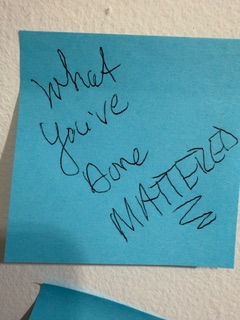
That is what the Global Rhythms exhibition is really about. In our old missions, right before our folks had to evacuate, they put up post it notes everywhere. They wrote messages thanking their local Foreign Service Nationals. Our main designer and organizer Liky had the brilliant idea to ask people to take photos of those notes and send them in. She then turned them into a giant and beautiful collage for the exhibit. It is our way of saying we have not forgotten the people left behind in developing nations.
We might not be in the field right now, but we are still here. We are pouring a century of grief, love, and resilience onto our canvases. We have photographers showing incredible work. We have watercolor artists capturing the beauty of the countries we served. We have sculptors who have used all their experiences into beautiful 3-D pieces. Together there were 40 of us who showcased our work, they are really superb.
Clinton, one of the brilliant minds who helped us organize the event, wrote a beautiful poem and read it out loud at the reception. It was all about how we cannot be put down. And he is right. No matter how many wood chippers they try to throw us into, they cannot stop our rhythm.
______________________________________________________________________________
Ongoing Event Information: Global Rhythms
If you want to see the artwork for yourself, I really encourage you to come out.Global Rhythms: Remembering USAID through the Arts is a multi media exhibition that speaks to the core of humanity. It transcends all the cultural and geographical borders we used to cross for our work. Our paintings, photographs, and poems depict the range of experiences from curious travelers to displaced persons and global professionals. They weave a story of cultural and social connections that make up the vibrant fabric of America and the partnerships that have built a better world. The exhibition celebrates the work of Americans who have promoted peace, saved lives, improved living conditions, and upheld democratic principles with passion and compassion.
Because of the tremendous response from over 40 artists, photographers, and poets who submitted over 100 pieces of artwork, we are holding two separate exhibitions. The first one runs from March 7 to March 31, and the second one runs from April 4 to April 29, 2026. You can find more details at the Compass Atelier website. Each exhibition will include a completely different set of artwork by our 40 artists, and each exhibition opens with a Meet the Artists reception from 2:30 to 5:30 pm.
Glen, the owner of the Compass Atelier, is a wonderful man. Because it is a teaching place, he has given us April as a free month to continue the exhibit just because he believes so much in our cause. It is a thousand dollar value given completely out of the goodness of his heart. You can also view the stunning artwork and learn more about our group at on this website and see the personal portfolio of Lily Kak, the lead organizer and a primarily watercolor artist, at lilykak.com.

Written by Roger D. Odipo following an interview with Mihira Karra.


Comments